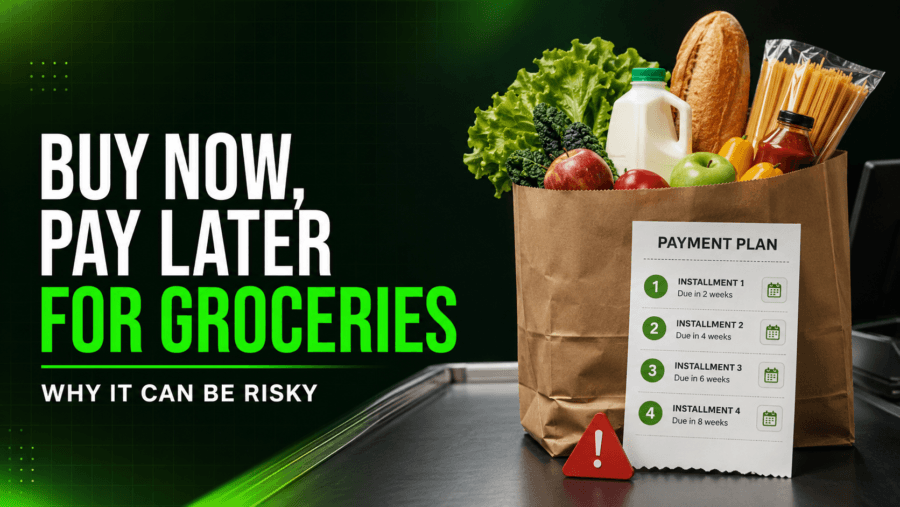
Using buy now, pay later for groceries can be risky because groceries are a recurring expense while the debt may remain for six weeks or longer. The payment plan does not reduce the cost of food. It moves part of today’s grocery bill into future paychecks.
Not every buy now, pay later transaction causes financial trouble. A genuine 0% plan may provide short-term flexibility when the entire purchase already fits within your budget. The risk increases when you need the plan because you cannot afford the groceries, have several payment plans running at once or must choose between an installment and another essential bill.
How Buy Now, Pay Later Works for Groceries
Buy now, pay later, commonly shortened to BNPL, is a form of installment credit. It allows you to receive a purchase immediately while paying for it over several scheduled installments.
A typical “pay in four” plan divides the purchase into four equal payments. The first payment is generally due at checkout, followed by three payments every two weeks.
Here is a hypothetical example for a $160 grocery purchase:
| Payment | Due | Amount |
|---|---|---|
| First payment | At checkout | $40 |
| Second payment | Two weeks later | $40 |
| Third payment | Four weeks later | $40 |
| Fourth payment | Six weeks later | $40 |
| Total | $160 |
Many pay-in-four plans advertise 0% annual percentage rate, or APR. APR represents the annualized cost of borrowing. However, longer repayment plans may charge interest, and even a 0% APR plan can lead to late charges, payment-rescheduling fees or bank overdraft fees.
Terms vary by provider and purchase. Always check the total repayment amount, APR, fee schedule, due dates, automatic-payment terms and consequences of missing a payment before accepting the offer.
How Common Is BNPL Grocery Spending?
The Federal Reserve’s August 2026 analysis, based on its nationally representative 2025 Survey of Household Economics and Decisionmaking, found that 16% of U.S. adults had used BNPL during the previous year.
The same research reported:
| Finding from the 2025 survey | Percentage |
|---|---|
| U.S. adults who used BNPL | 16% |
| BNPL users who used it for groceries or food delivery | 20% |
| BNPL users who paid late at least once | 26% |
| BNPL users who were charged extra after paying late | 17% |
| BNPL users whose payment triggered an overdraft or insufficient-funds fee | 11% |
The grocery figure applies to BNPL users, not all U.S. adults. Among people who had used BNPL for groceries or food delivery, 45% said their main reason for using BNPL was that it was the only way they could afford a purchase.
The research also found that grocery and food-delivery users were more likely to experience late-payment charges, overdrafts or insufficient-funds fees. This relationship remained even when comparing people with similar incomes.
Why Using BNPL for Groceries Can Be Risky
Groceries Are Used Before They Are Paid Off
A pay-in-four plan commonly lasts about six weeks. Most groceries will be eaten long before the final installment is due.
When the next grocery trip arrives, you may still owe money for food bought several weeks earlier. If you finance the next purchase too, your future paychecks must cover both new groceries and installments from previous orders.
Groceries should normally be included as a recurring need in your monthly budgeting plan. Treating them as a series of separate loans can hide the fact that regular expenses exceed the money currently available.
Several Small Plans Can Stack Up
Individual installments may look manageable because the checkout screen emphasizes today’s payment rather than the complete cost. Four $40 payments can feel cheaper than a $160 purchase, even though the total is the same.
Suppose you finance a second $160 grocery order one week after the first:
| Purchase | Total cost | Installment schedule |
|---|---|---|
| First grocery order | $160 | $40 in weeks 0, 2, 4 and 6 |
| Second grocery order | $160 | $40 in weeks 1, 3, 5 and 7 |
| Combined | $320 | Eight $40 payments |
Two purchases create a scheduled withdrawal every week for eight weekly payment dates. If you continue financing groceries every week, several installments eventually fall within the same week.
This is known as payment stacking. Each loan may appear small on its own, but the combined payment obligations can consume a large share of the next paycheck.
Autopay Can Trigger Bank Fees
Most BNPL installments are collected automatically from a checking account, debit card or credit card. Autopay can help prevent forgotten payments, but it does not confirm that enough money is available.
If a checking account lacks sufficient funds, the payment may be declined or trigger an overdraft or nonsufficient-funds fee, depending on the bank’s policies. The BNPL provider may also impose its own late charge or restrict the account.
If installments are charged to a credit card and the card balance is not paid in full, the card’s APR may apply. A purchase advertised as interest-free can therefore create interest elsewhere.
A 0% APR Plan May Still Cost Money
A 0% APR offer generally means the lender is not charging interest under the stated plan. It does not necessarily mean every possible cost is zero.
Potential costs can include:
- Late-payment charges
- Payment-rescheduling fees
- Bank overdraft or insufficient-funds fees
- Credit card interest on installments charged to a card
- Collection costs if an unpaid balance is sent to a debt collector
Some providers do not charge certain fees, while others do. Verify the current agreement rather than assuming all BNPL plans work the same way.
BNPL Can Make Spending Harder to Track
Traditional bills usually appear once per month. BNPL payments may be spread across several providers, apps, cards and due dates.
A shopper may remember the next $25 installment but overlook the other payments scheduled later that week. This makes it difficult to know how much of the next paycheck is already committed.
When reviewing affordability, count the full grocery price as spending in the month of purchase. The 50/30/20 budget calculator can help compare total needs, wants, savings and debt payments using take-home income. Do not enter only the first BNPL installment as the cost of the groceries.
Missed Payments May Affect Your Credit
Do not assume using BNPL will automatically build credit. At the time of the Federal Reserve’s 2025 survey, BNPL purchases and on-time payments generally were not affecting credit histories or scores at the three nationwide credit bureaus.
Reporting practices are changing, however, and different products have different policies. Longer-term installment plans may be reported, while an unpaid account sent to collections may appear on a credit report and potentially damage a credit score.
Before accepting a plan, check whether the provider reports applications, balances, on-time payments, late payments or collection accounts. A soft credit inquiry generally does not affect a credit score, but some longer-term financing applications may involve a hard inquiry.
Refund and Dispute Protections Can Differ
Grocery orders can still produce disputes involving missing items, duplicate charges, canceled deliveries or refunds. When a BNPL provider finances the transaction, the merchant and lender are separate companies. A merchant refund may not immediately cancel the remaining payment schedule.
As of August 2026, the CFPB’s official BNPL resource page states that the agency withdrew its 2024 BNPL interpretive rule on May 12, 2025. Consumers should not assume every BNPL plan provides exactly the same federal billing-dispute protections as a conventional credit card. Other federal or state laws may still apply depending on the product and circumstances.
The Federal Trade Commission’s BNPL guidance recommends checking the lender’s refund, dispute and missed-payment policies before using a plan. Keep the purchase receipt, financing agreement, payment confirmations and all communications with the merchant and lender.
If a dispute occurs, contact both companies and document each response. Continue following the agreement unless the lender confirms in writing that payments have been paused. An unresolved financial-product complaint may be submitted through the Consumer Financial Protection Bureau’s complaint process, while state attorneys general and consumer-protection agencies can explain rights under state law.
When Might BNPL Be Less Risky?
Using BNPL for groceries may present less financial risk when all of the following are true:
- You could afford the entire grocery bill without missing another obligation.
- The total purchase fits within your established grocery budget.
- The plan has 0% APR and you understand every potential fee.
- You have reviewed the exact installment dates and amounts.
- Enough money will remain available after rent, utilities, insurance, transportation, prescriptions and minimum debt payments.
- You have no other BNPL payments that could overlap.
- You understand the provider’s refund, dispute and credit-reporting policies.
- Your income is stable enough to cover every installment on time.
One cautious approach is to reserve the full purchase amount immediately, even though the lender collects it gradually. If you cannot set aside the remaining balance without affecting essential expenses, the plan is relying on future income rather than money already available.
What to Do If You Already Use BNPL for Groceries
1. List Every Outstanding Plan
Review every BNPL app, confirmation email and bank statement. Record the following information for each purchase:
- Remaining balance
- Next payment amount
- Every remaining due date
- Payment method
- APR, if applicable
- Possible late or rescheduling fees
Do not track only the provider you use most often. The goal is to calculate the total amount already committed from each upcoming paycheck.
2. Protect Essential Expenses First
Create a basic spending plan that prioritizes housing, utilities, insurance, food, necessary transportation, healthcare, taxes and minimum required debt payments. Do not skip these obligations to make additional payments beyond what is required on a BNPL plan.
If your expenses are difficult to organize, use a conservative budget based on income you can reasonably expect, not overtime, bonuses or side income that may not arrive.
3. Stop Creating New Payment Plans
Adding another BNPL purchase may provide immediate relief but increases the amount owed from future income. Pause new BNPL spending while bringing the existing schedules under control.
Use debit, cash or a predetermined weekly grocery amount when funds are available. Avoid replacing BNPL with a payday loan or cash-advance app without comparing the complete cost. Fast-access loans can include fees and automatic withdrawals that create a similar cycle.
4. Contact the Provider Before Missing a Payment
If an installment will be unaffordable, contact the provider before its due date. Ask whether it offers a hardship option, payment-date change or temporary extension.
Moving a payment may involve restrictions or fees, so request the new amount and date in writing. Changing the date does not eliminate the balance and may cause it to overlap with another bill.
5. Build a Repayment Plan
Pay at least the required amount on every debt. If a BNPL product charges interest or repeated fees, account for those costs when deciding where additional money should go.
The guide to budgeting while paying off debt can help balance required expenses with repayment. If BNPL is only one part of a larger debt problem, the debt payoff calculator can estimate repayment for debts with monthly payments and fixed APRs. Short-term biweekly BNPL schedules should still be tracked separately using their actual due dates.
6. Address a Recurring Grocery Shortfall
If groceries regularly exceed available income, the underlying issue is not the payment method. Review the amount spent, household size, food-delivery charges and how often purchases are made.
A practical guide to budgeting on a low income can help prioritize essentials without pretending every expense can simply be eliminated. Households facing food insecurity can also check eligibility for SNAP, WIC and local food-assistance programs through their state or local agencies.
7. Create a Small Cash Buffer
Once required payments are current, begin with a modest grocery cushion, such as enough to cover one additional week of essential food. A small buffer can prevent a delayed paycheck or unusually expensive grocery trip from creating another loan.
An emergency fund is intended for unexpected essential expenses, not permanently financing routine groceries. Learn how an emergency fund works and use the emergency fund calculator to create a target based on actual necessary expenses.
Alternatives to BNPL for Groceries
Possible alternatives depend on why the shortage exists:
- For a timing problem: Align grocery shopping with payday and use a weekly limit based on available cash.
- For inconsistent income: Build the budget around a conservative income estimate and reserve part of stronger pay periods for weaker ones.
- For high grocery costs: Plan meals around food already at home, compare unit prices, reduce food-delivery charges and substitute lower-cost products where practical.
- For an unexpected disruption: Use an existing emergency fund or available assistance before creating several overlapping loans.
- For an ongoing income gap: Review benefit eligibility, contact local food-assistance organizations and look for sustainable income or expense changes.
- For existing debt pressure: Protect essential bills and required minimum payments while creating a complete repayment plan.
A credit card is not automatically a safer alternative. It may provide clearer billing-dispute rights, but carrying the balance can result in substantial interest. Compare the total cost and protections rather than choosing a payment method based only on the size of the first payment.
The Bottom Line
Buy now, pay later can divide a grocery bill into smaller installments, but it cannot make food more affordable. Because groceries must be purchased repeatedly, financing them can create overlapping payments that compete with future grocery trips and essential bills.
The clearest warning sign is needing BNPL every week because current income does not cover food. In that situation, adding more plans can deepen the cash-flow shortage. Track the complete balance, stop stacking new purchases, protect essential obligations and address the underlying budget or income gap as early as possible.